Saturday, November 07, 2020

The Empty Ideology of Right-to-Life

A psychoanalytic  approach to ideology as a social psychological mechanism for reconciling our basic drives(the Id) with our social connections(the Big Other/Super Ego) offers a way to think about resistance to reproductive freedom. Specifically, opposing a woman’s right to choice in having an abortion is a way to perform a kind of fundamental sanctity that appeals to conservatives. This comports with the intrinsic cynicism of ideology in that this performance has no immediate cost to those espousing it. Men, specifically, cannot have abortions, so the cost of opposing them is minimal. Moreover that ideological cynicism can easily admit for personal exceptions. So the hypocrisy inherent in privately procuring an abortion while publicly decrying abortion is totally in line with how ideology functions. Ideology attempts to reconcile the fundamentally self-absorbed id, with the social demands of the super ego. As Slavoj Žižek claims “renounce everything as ideology demands, and you can have it all”.(Žižek & Fiennes 2011) Ideology functions as symbols whose meaning changes as necessary to allow the fundamental drives, such as for sex, food and survival, to be realized.


My reasoning behind this analysis comes from the work of two thinkers. Žizek argues for this conception of ideology, as arising from a philosophy grounded in psychoanalytic theory. The notion of sanctity as a category of moral emotion comes from the work of Jonathan Haidt. 

Haidt offers 5 categories of moral emotion:(Graham et al, 2009)

  1. Care/harm
  2. Fairness/cheating
  3. Loyalty/betrayal
  4. Authority/subversion
  5. Sanctity/degradation.

The first two categories are broadly shared by both those self-described as liberals, and self-described conservatives in the US context. However, the last three values are relatively unimportant to Liberals, while these remain strong moral emotions for conservatives. It is the last of these, Sanctity, that I am attempting to address in this post.

The fetus is portrayed in anti-choice arguments as the most innocent, most defenceless of lives. It has no power or possibility to choose evil or good. It is almost, in christian terms, pre-lapsarian. Indeed, the sinfulness of humans occurs with their birth in most Christian theology.I those terms is fairly easy to interpret the fetus as a symbol/site of sanctity. Thus arises the conservative rejection of abortion, as an attack on a fundamental symbol of religious sanctity. 

By opposing abortion as an attack on sanctity, its opponents can claim a fundamental, unassailable commitment to sanctity, a cardinal moral emotion. Though admitting to their fundamental sinfulness, they can assert their commitment to a moral code. At the same time, this commitment requires little personal effort on their part. The effort of protesting is not of the same nature, as its value is achieving honour i.e. personal acclaim.

It requires little personal effort to avoid having an abortion oneself, but protesting it has social rewards.


References

Graham, Jesse, Jonathan Haidt, and Brian A. Nosek. "Liberals and conservatives rely on different sets of moral foundations." Journal of personality and social psychology 96, no. 5 (2009): 1029.

Žižek, Slavoj, and Sophie Fiennes. The pervert's guide to ideology. British Film Institute/Channel Four Television Corporation, 2011.

Sunday, April 21, 2019

Hellboy (2019): Talented cast betrayed by a weak script

The most recent Hellboy film suffers from a week script that betrays the talents of a talented cast and competent director. It attempts to explore the plight of the outsider, both as an individual and a group. Yet it fails to follow through the emotional arcs to a logical and satisfying conclusion. The result is that David Harbour’s nuanced portrayal of Hellboy is not supported by the events portrayed. The clumsy use of exposition—conjuring up dead characters to explain plot holes—also conveys a sense of lazy writing. 

An example of a failed emotional arc is Hellboy’s relationship to his nemesis, the witch Numia. She comes to him in a vision, and calls for him to join her as her consort, and free all the magic folk from their oppression at the hands of humans. Given that earlier in the film, an allied anti-paranormal group had ambushed him and attempted to brutally assassinate him, we can can see how he later storms out of his father’s office, accusing Ian McShane’s character of “turning me into a weapon...to slaughter my brother’s and sisters!” After asking repeatedly of his adoptive father, “,then what” McShane’s Prof Bruttenholme tells him he will kill the next enemy after that. Yet in the next scene with Numia, all feelings of romance and solidarity with other magic folk vanishes, and he coldly shoots her in the head, graphically portrayed. David Harbours Hellboy as working-class philosopher is reduced by weak plotting to a sociopath, at best just following orders.

The themes of a conflicted hero, trying to suppress his origins and live in a world hostile to his kind were also explored in the previous attempts to bring Hellboy to the screen. Hellboy as a working-class poet resisting a restrictive system gave room for a certain magic. Visually, Benicio Del Toro’s monsters were beautiful, if terrifying. The notion that they lived, partially hidden, around non-magical human’s left us with the possibility of a modus vivendi, one which humans had betrayed. In Neil Marshall’s Hellboy (2019), the action is competent, but the moral and emotional stakes are washed away and forgotten in almost comical seas of gore. 

The political background to this story, conflict with a perceived other, attempts to address the rise of contemporary nationalism and racist tropes. But it ultimately fails to do just to this ambition. This is because it’s villains are not merely flawed, but simply evil. They exist only to avenge those that had thwarted their evil. Thus Numia is not an ambitious leader eager to free her people, as with the Elvin prince in Hellboy: The Golden Army (Benitio Del Toro, 2008). Rather, her throngs are cannonfodder for her own narcissism. She declares that she will “kill everyone he loves” to force Hellboy to join her. Later, she kills her most loyal henchman when his annunciated objectives run counter to hers.

Ultimately, the most recent attempt to bring Hellboy to cinema lacks the charm and humour of the previous two films. A crude attempt at a darker portrayal, and the lack of emotional depth in the plot leaves this version unsatisfying. This despite a talented and charming cast of David Harbour, Sasha Lane and Daniel Dae Kim. If a sequel were attempted, and that was clearly in the minds of the writers, Andrew Cosby and Hellboy creator, Mike Mignola, this cast deserves a better and more tighter, more consistent script to work with.

Sunday, December 30, 2018

Going off the Rails: Anthropogenic Climate Change as a trolley problem

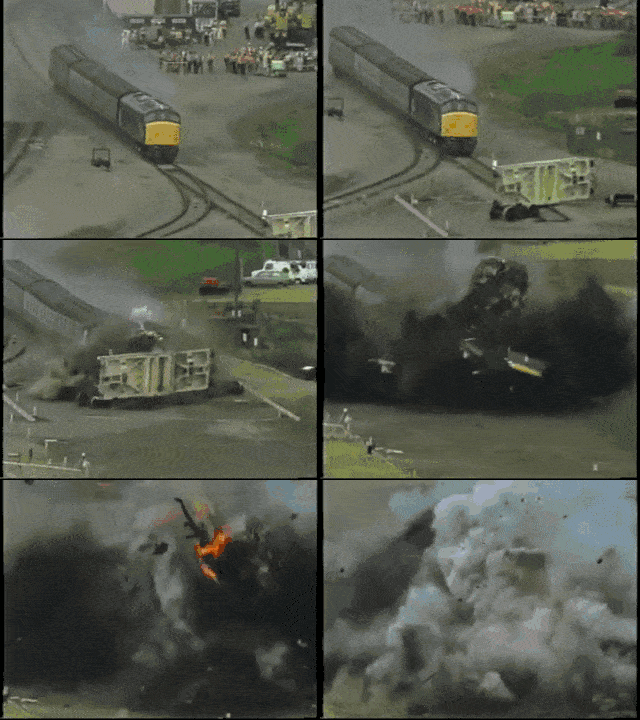
Consider an out-of-control train as an analogy for contemporary climate change:

The Philipa Foote's trolley problem creates an artificial situation of choosing action, or inaction, with no good outcomes. It is at best an inexact analogy as we are riding on the trolley. If the term anthropogenic is an appropriate adjective for the climate change happening around us, then perhaps it is better to say we are that train.
At the least, we are on the trolley, and we have the choice of jamming on the breaks, causing the vehicle to jump the tracks, injuring many riders and killing others. We can choose to let the cart continue on its way, until it jumps the track and injures many riders and kills others. Finally, we can slow it to a stop, while we build a replacement that won’t endanger us. Then the question is how long can we take to brake. What will case the least disruption(the fewest injuries), knowing the longer we wait the more likely that a wreck will result.

For the purposes of this thought experiment, I will not engage with those that think the trolley can continue, or even accelerate. That is wishful thinking. We do not have time to entertain reductio ad absurdum arguments.

Indeed, time is the question. If we were to stop all fossil fuel use tomorrow, much of the human species would be starving in days, weeks or at most, months. We are that dependent on fossil fuels to cultivate, fertilize, transport and store food. Yet to continue on the path as we are going on would lead to a planet unable to sustain human civilization, and quite possibly any human life. The climactic effects of fossil fuel use will destroy agriculture as we know it by making much of the earth’s arable lands unusable. The time frame for this process is measured in decades to centuries.

This time frame seems long when human life occurs in temporal frames of days, weeks and months. Our economy tends to measure value in quarters, three month periods. Our lived experience is on a shorter time frame. If we don’t eat for a day, or have water for a few hours, we begin to suffer. For many, though we may save for the future, we are focussed on the rent or mortgage due at the end of the month. The trolley wreck of climate change seems too slow. Few can ignore the immediate catastrophe of loosing one’s house, due to unemployment, against the long term goal of sustaining of the climate.

How we understand these time frames is the key to selecting a time frame for change. How we disburse the pain of reducing fossil fuel consumption, and so atmospheric CO2 concentrations and catastrophic climate change is a temporal question that varies with wealth, power and privilege.

Ronald Wright’s description of how the Mayan civilization collapsed after a successful 800 year history offers a parallel perspective on an advanced civilization that doubled down on the meaning of their success, and so wrecked themselves. How we experience time as agents is worth considering in order to reveal the often unperceived effects of climate change.

Monday, December 25, 2017

Christmas Turkey 2017

This year, I wet brined the bird, having bought it fresh from boucherie Notre Dame. The brine was a 1 1/2 cup of course sea salt, a Tbls of cracked pepper, fresh thyme, sage and rosemary. It was left to brine overnight and removed just before roasting. The bird is 15lbs, so should require 5 hours at 325F. I also received a fancy new broiling pan as a present.   The bird was loosely stuffed with lemon slices, and more herbs as above. I also drizzled it with bacon fat from this morning’s breakfast. I poured two cups of chicken broth into the pan, to help with basting. The bird starts flipped over, to encourage self-basting from the fattier under-belly of the bird. At 90minutes I’ll remove it from the oven, flip it over and baste it. I will also lower the heat to 325F. 


The bird will come out 90 mins from 13h10 for basting and to be flipped. I took the opportunity to empty and clean the brining vat, and clear and clean the kitchen counters. 


Sunday, August 07, 2016

Pulled Pork with red wine barbecue sauce

The finished pork, with sauce in the back ground
My cousin and her family were coming for a visit, and we wanted something special but informal for a dinner. Especially as they had a long drive, finally through the tangled mess that is Montreal's road repairs. I chose pulled pork and have a little photo essay to accompany it.

The pulled pork itself was purchased the day before. It was a 9lbs butt roast. It was coated with worchestershire(Woos-ta-shire) sauce then mustard.  "Steak spice" was used as a dry rub, patting that on, then finally sprinkling smoked paprika to finish. The entire cut of meat, including any flaps, were coated.

The meat was wrapped in plastic wrap and left to sit over-night in the fridge.

Remove the plastic wrap before you place the pork on a foil wrapped roasting tray, and slip it in the oven.

9lbs of pork requires approximately 9 hours at 250F, so I started early to make sure I could feed the folks when they arrived. In the end, the roast required only 8 hours to reach 190F, at which point it was removed from the oven, wrapped in foil and a couple of clean towels to rest. In this case I left it for 1hour 35mins, but it requires at least an hour to reach maximum juiciness.

While the pork slow roasted, I made the barbecue sauce.
Olive oil and chili flakes on medium low heat

Two large cloves of garlic, mashed flat with the side of a cleaver

Diced fresh ginger

Saute the ginger and garlic

Add a couple of cups of wine. I did this instead
Malt vinegar, bourbon or mustard, which is the
basis of many fine recipes. The wine and ginger
worked very well, and my sone said it tasted a bit
like "asian barbecue".

add a 1/2 cup of brown sugar

Add half teaspoon of smoked paprika

Add a grated carrot. This is a great trick for adding
a subtle sweetness and roundness to recipes. It also
helps tame a sauce if it is too spicy.

Reduce the sauce on medium low to
desired consistency. It took a good
3 hours for this stage. By the end, the carrot
had broken down almost completely into the sauce.

At 4 hours,  'painting' the pork with sauce.

170 degrees at 4 hours! but it took
 another 3 hours to reach 190F

Out of the oven at 8 hours, and 190F
 internal temperature 

Wrap in foil and towel and left rest for an hour.
The meat will retain its heat for several hours
like this, so you can hold it 'til guests arrive.
After resting for an hour and a half, the meat
was beautifully tender and juicy.

Pulled Pork with red wine barbecue sauce

The finished pork, with sauce in the back ground
My cousin and her family were coming for a visit, and we wanted something special but informal for a dinner. Especially as they had a long drive, finally through the tangled mess that is Montreal's road repairs. I chose pulled pork and have a little photo essay to accompany it.

The pulled pork itself was purchased the day before. It was a 9lbs butt roast. It was coated with worchestershire(Woos-ta-shire) sauce then mustard.  "Steak spice" was used as a dry rub, patting that on, then finally sprinkling smoked paprika to finish. The entire cut of meat, including any flaps, were coated.

The meat was wrapped in plastic wrap and left to sit over-night in the fridge.

Remove the plastic wrap before you place the pork on a foil wrapped roasting tray, and slip it in the oven.

9lbs of pork requires approximately 9 hours at 250F, so I started early to make sure I could feed the folks when they arrived. In the end, the roast required only 8 hours to reach 190F, at which point it was removed from the oven, wrapped in foil and a couple of clean towels to rest. In this case I left it for 1hour 35mins, but it requires at least an hour to reach maximum juiciness.

While the pork slow roasted, I made the barbecue sauce.
Olive oil and chili flakes on medium low heat

Two large cloves of garlic, mashed flat with the side of a cleaver

Diced fresh ginger

Saute the ginger and garlic

Add a couple of cups of wine. I did this instead
Malt vinegar, bourbon or mustard, which is the
basis of many fine recipes. The wine and ginger
worked very well, and my sone said it tasted a bit
like "asian barbecue".

add a 1/2 cup of brown sugar

Add half teaspoon of smoked paprika

Add a grated carrot. This is a great trick for adding
a subtle sweetness and roundness to recipes. It also
helps tame a sauce if it is too spicy.

Reduce the sauce on medium low to
desired consistency. It took a good
3 hours for this stage. By the end, the carrot
had broken down almost completely into the sauce.

At 4 hours,  'painting' the pork with sauce.

170 degrees at 4 hours! but it took
 another 3 hours to reach 190F

Out of the oven at 8 hours, and 190F
 internal temperature 

Wrap in foil and towel and left rest for an hour.
The meat will retain its heat for several hours
like this, so you can hold it 'til guests arrive.
After resting for an hour and a half, the meat
was beautifully tender and juicy.

Friday, May 22, 2015

Not as a consumer or producer but rather as a human being

"God created man not as a consumer or producer but rather as a human being. That the means of life should not be the goal of life. That the stomach should not outgrow the head. That life is not exclusively based on the profit motive. That a human being is allotted time in order to have time and not to arrive somewhere faster with his legs than with his heart." -Karl Krause 
from 
The Kraus Project: Essays by Karl Kraus,
translated and annotated by Jonathan Franzen, 


Wednesday, January 15, 2014

2013- we hardly knew ye

2014 starts with me taking a few minutes off to write a blog post, when i should be finishing a conference paper for the Canadian Game Studies Association. I'm in year two of my doctoral studies, and can finally begin to define myself as a Philosopher who studies the aesthetics of digital games and the ontology of play.

The family are doing well, with the boy growing like a weed. The missus is still managing a research group at the MUHC and studying to specialise in human resource management. yes, kiddies, school never stops, training is the new normal. Its generally the fastest way to acquire new skills as the world changes.

What got me writing this morning was the elf-on-a-shelf phenomenon, which is a cute pseudo-tradition that supports a cynical marketing ploy. My wife and I amused ourselves with fun ways to subvert this. Don't buy the elves, make your own. Create stories about hiring unemployed elves that are looking for work after Santa moved his workshop off shore. Have your elf-on-a-shelf engage in anti-social, irresponsible or inappropriate behavior as he vies to become the NSA's "snitch of the year".


Wednesday, May 02, 2012

Those self-entitled students

I'm not talking about the University students in Québec. I'm talking about those ingrates in High School. We know most don't work very hard or apparently learn very much(have you tried reading a 1st year uni student's essay, lately?). So why do we bother paying for public highschool? Let them work, I say, and if they want more than flipping burgers, they can save for high school.

Regardless, at least 1% of the population have the wherewithall to make sure their kids get a decent High School education. So there will be a future generation to lead our people, who are all a bunch of free-loaders, what with their medicare, and subsidised daycare and free elementary education.

At least now parents have to bake cookies and buy most of the children's supplies. It gets those free-loading children and their parents off their lazy asses. Children in some countries go to work. They understand the value of smashing bricks into gravel. And they learn it young, typically age 5.

So why should we pay for university educations? Or any educations? Let the kids pay for their crummy educations.

Oh yeah, we'll pay for their education or the lack off it, one way or the other.

Sunday, October 16, 2011

Occupy Montréal: Why?


Over a thousand people gathered in Victoria Square, the center
of Montreal's financial district, to "Occupy Montréal"
 The Occupy Movement has drawn disparate campaigners for a variety of  causes together. This has caused many to accuse the movement of being directionless or un-serious. In reality the people occupying Wall Street, London and other financial centers around the globe see these institutions as being the source of many global problems. While the previous global recession can immediately be linked to financial and political mismanagement of the economy, protestors also see how environmental concerns, the plight of aboriginal peoples, military actions, the stagnation of middle class incomes, the growth of impoverished underclasses in even the wealthiest nations and the continued success of dictators are all tied to a financial elite that holds undue influence over governments, democratic or not, whether international, national, regional or local.
The interests of a few include the senior executives
of major media and diversified corporations.

In Canada, stricter banking regulations protected our economy from the financial mismanagement that wounded much of the world's economy. However, the current government had advocated removing those restrictions, prior to the recession. Moreover, incomes have stagnated in Canada for more than a generation, although Canadian workers productivity has shown massive gains. Like people around the world, Canadian citizens have to work more and more to earn the same income, and this in an era of massive increase of corporate profit and GDP growth. Coupling this with environmental exploitation, this isn't seen as business development, but as a return a sort of technocratic feudalism. So many Canadians see these protests as the last, best hope for maintaining political and economic justice here and around the world.

Few believe that solutions to balancing human needs, environmental limitations and a sustainable economy will be simple, but all see this elite as being responsive only to its own narrow and short-sighted interests. Even those who consider themselves capitalists do not recognise this as anything but a kleptocracy. A kleptocracy that relies on the political class of various countries to act as partners or shills for policy that benefits the 1% to the detriment of the other 99%.

Certainly, you can find funny hats, and protestors that can only ramble incoherently. But these are a sliver of those that see the far reaching ramifications of a global class that plays Monopoly with the wealth produced by an increasingly disenfranchised majority. And unfortunately some believe that by allying themselves with the "1%" they will be allowed to join it. Yet their loyalty is exploited- we only have to look toward the behavior of some Police forces in their actions toward peaceful protest. But on closer examination the majority of the Occupy movement are citizens demanding democratic representation and economic opportunities that don't rely on onerous exploitation of people or the environment.
The police presence at Occupy Montréal was very visible, but
admirably subdued. For the most part, soldiers and police officers
are part of the 99% as much as these two women.


"If I had to choose between betraying my country and betraying my friend, I hope I should have the guts to betray my country."
-E.M. Forster